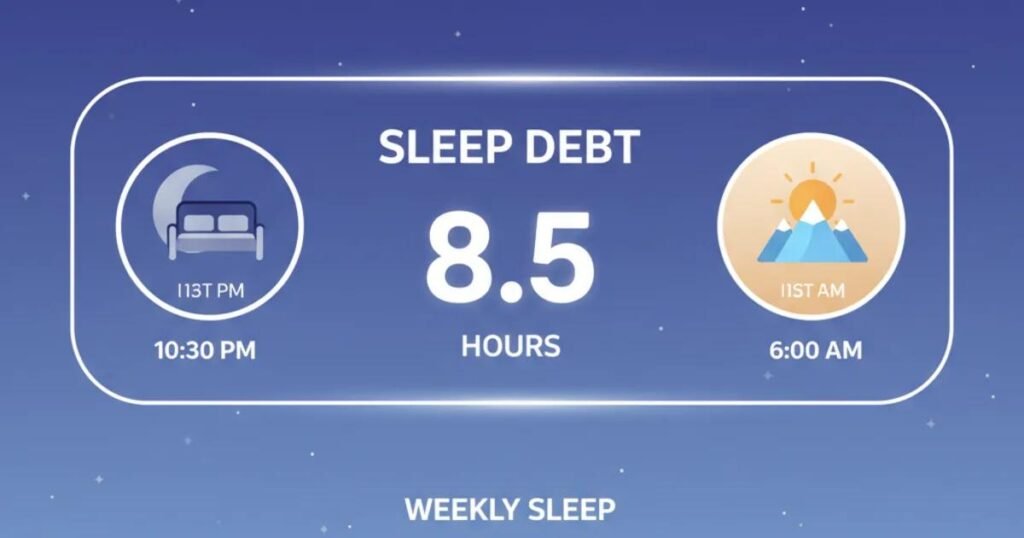
Do you wake up tired even after sleeping longer on weekends? The reason may be accumulated sleep loss. Understanding how to calculate sleep debt helps you identify whether your body is getting enough rest and how much recovery sleep you may need.
Sleep debt is calculated by comparing the amount of sleep your body requires with the amount you actually get. Even losing one hour of sleep each night can create a significant deficit over time.
This guide explains the sleep debt formula, step-by-step calculation methods, examples, and strategies for recovering from sleep loss
What Is Sleep Debt?
Quick Answer
Sleep debt is the total amount of sleep you have missed compared with the amount your body needs for healthy functioning.
For example, if your ideal sleep requirement is 8 hours but you only sleep 6 hours, you create 2 hours of sleep debt for that night. Repeating this pattern over several days increases your total sleep debt.
How Is Sleep Debt Calculated?
Quick Answer
Sleep debt is calculated by subtracting your actual sleep hours from your required sleep hours and adding the difference over multiple days.
The calculation can be performed manually or automatically using a sleep debt calculator.
Sleep Debt Formula
The basic formula is:
\text{Sleep Debt}=(\text{Sleep Needed}-\text{Sleep Received})\times\text{Number of Days}
This formula estimates the total number of hours your body has missed over a selected period.
Step-by-Step Guide to Calculate Sleep Debt
Step 1: Determine Your Ideal Sleep Requirement
Most adults generally require 7–9 hours of sleep per night, although individual needs vary based on age, health, activity level, and genetics.
Example:
- Your ideal sleep: 8 hours per night
Step 2: Track Your Actual Sleep Time
Record your:
- Bedtime
- Wake-up time
- Total hours asleep
- Sleep interruptions
You can track this information using:
- A sleep journal
- Smartphone sleep applications
- Wearable sleep trackers
Step 3: Calculate Your Daily Sleep Loss
Subtract your actual sleep from your required sleep.
Example:
- Needed sleep: 8 hours
- Actual sleep: 6 hours
Daily sleep debt:
8 − 6 = 2 hours
Step 4: Add Your Total Sleep Debt
Add the daily deficits over several days.
Weekly Sleep Debt Example
| Day | Sleep Needed | Actual Sleep | Daily Debt |
|---|---|---|---|
| Monday | 8 hours | 6 hours | 2 hours |
| Tuesday | 8 hours | 6.5 hours | 1.5 hours |
| Wednesday | 8 hours | 7 hours | 1 hour |
| Thursday | 8 hours | 5.5 hours | 2.5 hours |
| Friday | 8 hours | 6 hours | 2 hours |
| Total | — | — | 9 Hours of Sleep Debt |
This shows how small nightly sleep losses can accumulate into significant weekly sleep debt.

How Much Sleep Debt Is Too Much?
There is no universal number that defines excessive sleep debt because individual sleep needs differ.
However, a general guide is:
| Total Sleep Debt | Possible Effect |
|---|---|
| 0–2 hours | Minimal impact for most people |
| 3–7 hours | Mild tiredness and reduced focus |
| 8–15 hours | Noticeable fatigue and concentration problems |
| 15+ hours | Significant sleep loss requiring consistent recovery |
Even smaller deficits can affect performance when they happen repeatedly over weeks or months.
How to Track Your Sleep Debt More Accurately
Manual calculations are useful, but a dedicated tool makes tracking easier.
A Sleep Debt Calculator can:
- Calculate your accumulated sleep loss
- Monitor weekly sleep patterns
- Help estimate recovery time
- Increase awareness of unhealthy sleep habits
Tracking your sleep regularly allows you to notice patterns before they become serious.
How to Recover From Sleep Debt
1. Increase Sleep Gradually
Add 30–60 minutes of extra sleep each night instead of dramatically changing your schedule.
2. Maintain a Consistent Sleep Schedule
Sleeping and waking at the same times every day helps maintain a healthy circadian rhythm.
3. Improve Sleep Quality
Support better sleep by:
- Keeping your bedroom cool, dark, and quiet
- Avoiding caffeine late in the day
- Limiting bright screens before bedtime
- Following a relaxing nighttime routine
4. Use Naps Strategically
Short naps of 10–20 minutes can temporarily improve alertness without interfering with nighttime sleep.
A Nap Calculator can help determine the best time to nap and wake up.
5. Manage Travel-Related Sleep Loss
Long-distance travel can disturb your internal body clock and contribute to temporary sleep debt.
A Jet Lag Calculator can help you adjust your sleeping schedule before and after crossing time zones.
Expert Tip: Look at Your Weekly Sleep Average
A single short night of sleep usually is not a major problem. The bigger issue is a consistent pattern of sleeping less than your body requires.
Checking your average weekly sleep duration gives a clearer picture of your overall sleep health.
Frequently Asked Questions
What is the formula for calculating sleep debt?
Subtract your actual sleep hours from your required sleep hours and add the difference across multiple days.
How do I calculate my weekly sleep debt?
Add the sleep you missed each night throughout the week to find your total sleep debt.
How many hours of sleep debt can I recover in one night?
One night of extra sleep may reduce mild sleep debt, but larger deficits usually require several days or weeks of consistent recovery.
Is a sleep debt calculator accurate?
A sleep debt calculator provides a useful estimate based on your reported sleep data, but it does not diagnose sleep disorders.
Can sleeping extra on weekends eliminate sleep debt?
Weekend catch-up sleep may help reduce tiredness temporarily, but maintaining a regular sleep schedule is usually more effective.
Conclusion
Knowing how to calculate sleep debt gives you a clearer understanding of your sleep habits and whether you are getting enough rest. By comparing your ideal sleep needs with your actual sleep hours, you can identify accumulated sleep loss and make a practical recovery plan.
Use a Sleep Debt Calculator for faster tracking, maintain a consistent sleep routine, improve sleep quality, and use helpful tools such as a Nap Calculator and Jet Lag Calculator to support your overall sleep health.