One of the first questions travelers ask after booking an international flight is:
“How long will it take to recover from jet lag?”
Unfortunately, there isn’t a perfect answer because recovery depends on several factors. However, sleep researchers and travel experts often use practical formulas and estimates to predict how quickly the body may adapt to a new time zone.
Understanding the jet lag recovery time formula can help you plan business trips, vacations, competitions, and important events more effectively.
Instead of guessing how you’ll feel after arrival, you can make more informed decisions about your schedule and recovery expectations.
What Is the Jet Lag Recovery Time Formula?
Quick Answer
A commonly used jet lag recovery formula is:
Recovery Time ≈ 1 Day Per Time Zone Crossed
For example:
| Time Zones Crossed | Estimated Recovery Time |
| 3 Time Zones | 2–4 Days |
| 5 Time Zones | 4–6 Days |
| 8 Time Zones | 7–9 Days |
| 12 Time Zones | 10–14 Days |
This formula is not exact, but it provides a practical starting point for estimating recovery.
Why Does Jet Lag Recovery Take Time?
Jet lag occurs when your internal body clock becomes out of sync with local time.
Your circadian rhythm controls:
- Sleep timing
- Wakefulness
- Hormone production
- Body temperature
- Energy levels
When you travel across multiple time zones, your body cannot instantly adapt.
Instead, your circadian rhythm gradually shifts toward the new schedule.
Factors That Affect Jet Lag Recovery
The simple formula works as a general guideline, but many factors influence actual recovery.
Number of Time Zones Crossed
Generally:
- More time zones = Longer recovery
A two-hour time difference is often easier to manage than a ten-hour shift.
Direction of Travel
Eastward travel is usually harder than westward travel.
Examples:
- New York → London
- Los Angeles → Paris
These routes often require travelers to fall asleep earlier than normal.
Age
Older adults sometimes require longer recovery periods.
Sleep Habits
People with consistent sleep schedules often adjust more smoothly.
Light Exposure
Proper sunlight exposure can significantly influence adaptation speed.
Eastward vs Westward Recovery Formula
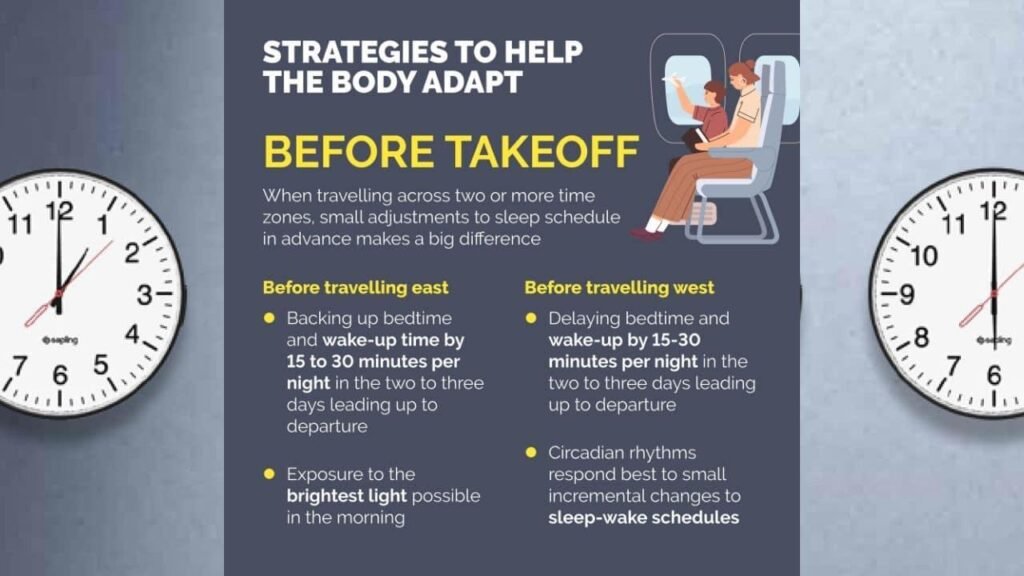
Although the basic formula remains useful, direction matters.
| Travel Direction | Typical Recovery Difficulty |
| Eastward Travel | Higher |
| Westward Travel | Lower |
Eastward Travel
Travelers often need:
- Earlier bedtimes
- Earlier wake-up times
This tends to feel more difficult.
Westward Travel
Most people adapt more easily because staying awake longer feels more natural.
For this reason, actual recovery may be faster than the simple formula predicts.
Helpful Sleep Tools
Travelers often use multiple sleep-planning tools together to improve recovery:
A Sleep Calculator can help determine ideal sleep timing after arrival, while a Nap Calculator can help prevent naps that interfere with nighttime adaptation.
Can Naps Affect Recovery Time?
Quick Answer
Yes.
Strategic naps may improve alertness during recovery, while poorly timed naps may delay adaptation.
Short naps can help:
- Reduce fatigue
- Improve focus
- Increase productivity
Long naps may:
- Delay bedtime
- Disrupt circadian adjustment
Many travelers use a Nap Calculator to control nap duration while recovering.
Jet Lag Recovery Formula Examples
Example 1: New York to London
Time Difference:
5 hours
Estimated Recovery:
4–6 days
Example 2: Los Angeles to Tokyo
Time Difference:
Approximately 16–17 hours depending on daylight savings adjustments.
Estimated Recovery:
10–14 days
Example 3: London to Dubai
Time Difference:
Approximately 4 hours
Estimated Recovery:
3–5 days
Actual recovery varies from person to person.
How Light Exposure Changes the Formula

Light is one of the most powerful circadian rhythm signals.
Morning Light
Can help advance your body clock.
Evening Light
Can help delay sleep timing.
Strategic light exposure may shorten practical recovery times for many travelers.
Can You Speed Up Jet Lag Recovery?
Quick Answer
You cannot completely eliminate adaptation time, but you can often reduce symptoms.
Helpful strategies include:
- Gradually adjusting sleep schedules before departure
- Following local time immediately after arrival
- Managing light exposure
- Staying hydrated
- Using strategic naps
These methods may improve comfort during recovery.
Why Some Travelers Recover Faster
Recovery rates vary due to:
- Genetics
- Circadian rhythm flexibility
- Sleep quality
- Travel experience
- Overall health
Two people taking the same flight may experience very different recovery times.
Is There a Perfect Jet Lag Formula?
Quick Answer
No.
The one-day-per-time-zone guideline remains one of the most practical estimates available, but no formula can predict recovery perfectly.
Individual differences always play a role.
Frequently Asked Questions
What is the jet lag recovery time formula?
A common guideline suggests approximately one day of recovery per time zone crossed.
Is eastward travel harder?
Yes. Most people find it more difficult to fall asleep earlier than to stay awake later.
Can naps speed recovery?
Short naps may help reduce fatigue, but long naps can slow adaptation.
Does age affect jet lag recovery?
Yes. Older adults may require more time to adjust.
Can a Jet Lag Calculator predict recovery exactly?
No. It provides estimates based on common circadian rhythm patterns.
Conclusion
The jet lag recovery time formula provides a useful framework for estimating how long adaptation may take after crossing multiple time zones. While recovery varies between individuals, factors such as travel direction, sleep habits, and light exposure all influence the process.
By understanding these factors and planning ahead, travelers can reduce fatigue, improve sleep quality, and adapt more comfortably to new destinations.