The integration of Artificial Intelligence (AI), Internet-Connected Devices, and Growing Multi-Cloud Systems poses a challenge to the seamless integration of heterogeneous systems – differing in architecture, intelligence, data arrangements, and communication protocols. The advancement of digital ecosystems continues to grow, yet a large number of organizations contend with a fragmented ecosystem comprised of data silos, incompatible systems, and outdated hardware infrastructure.
This precisely explains the unprecedented attention Nexus AlienSync is receiving and is still in the process of defining across multiple sources. AlienSync is described as a layered, intelligent, Adaptive Synchronization and Integration solution, combining multiple systems to provide unmatched speed, security, and interoperability.
Unlike traditional sync engines that simply move data to various devices, AlienSync offers a unified self-learning synchronization orchestrating artificial intelligence models, heterogeneous distributed systems, cloud infrastructure, edge devices, and human-computer interfaces.
Nexus AlienSync will be the focus of this review. The architecture, features, use cases, advantages, challenges, and new horizons it may facilitate for AI-powered digital ecosystems will all be covered. This will be beneficial for enterprise leaders, IT architects, AI advocates, and technology researchers. This will provide a first-hand perspective of what AlienSync can provide with respect to the interconnected systems of the future.
What Desribes AlienSync?
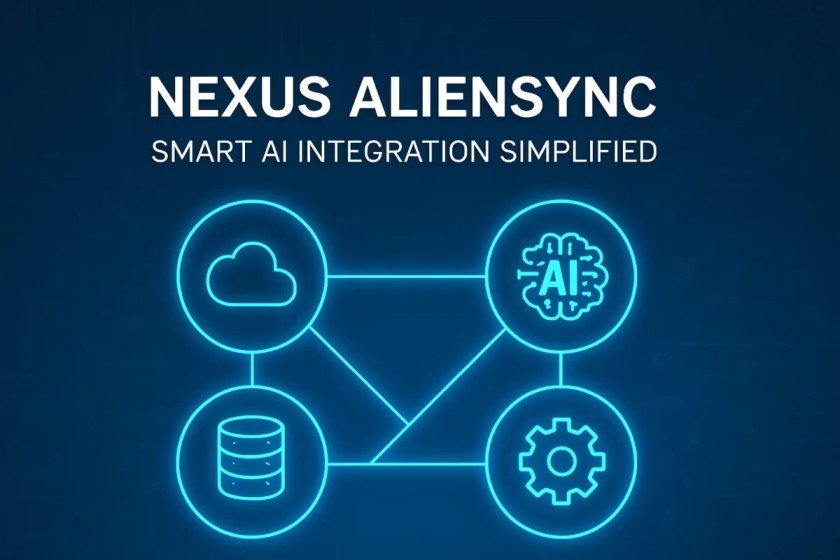
The AlienSync nexus of devices is a hybrid synchronization framework according to one of the primary websites. This seamless integration of artificial intelligence, device connectivity, and real-time data orchestration is a sophisticated, practical framework. AlienSync is a technology designed to make the interoperability of disparate digital systems possible.
A Unifying Synchronization Layer for Complex Systems
AlienSync is not limited to file or data synchronization. Instead, it acts as a unifying layer across:
- AI models
- IoT devices
- Cloud solutions
- Edge computing
- Business systems
- Autonomous systems
- Multi-agent artificial intelligence
- Human-machine interfaces
Thus, it is far more sophisticated than most other competitive solutions for data or file synchronization and other integration platforms.
Why We Need Nexus AlienSync Today
- Today’s modern technological ecosystems face a variety of problems:
- Systems communicate via incompatible protocols.
- AI-driven models require real-time unified synchronization.
- The devices generate real-time high-frequency data streams that cloud servers alone are unable to process.
- Data security protocols must ensure secure compartmentalized node to node transmission.
- Enterprises require scalability without the need for redesigning.
Nexus AlienSync aims to address the above challenges by utilizing a sophisticated and flexible synchronization engine designed to eliminate the silos between heterogenous technological systems
Nexus AlienSync ‘s Core Architecture
Currently, there is no authoritative public technical documentation that provides a complete definition of AlienSync, but the concept continually revolves around the multi-layered architecture comprising of intelligent routing, protocol conversion, real-time data stream processing, and secure communication.
The following is a summarized architecture view based on a high-ranking textual pattern synthesis and synchronization frameworks.
1- Communication Layer
The layer guarantees stable and reliable communication between devices, applications, and AI models. Is characterized by:
- Low-latency communication channels
- Auto detection of devices or system type
- Multiple data format support
- Adaptive bandwidth allocation
Whether it is synchronizing between two smartphones or a distributed cluster of AIs, the communication layer ensures seamless and uninterrupted connectivity with minimal latency at all times.
2- Intelligent Translation Engine
The ability to translate protocols, models, and commands between incompatible systems, is without a doubt one of the most important functionalities for this system. All components of this program perform the following tasks: Data normalization, model compliance mapping, semantic translation for AI outputs, and API or protocol translation. An AI vision model and an IoT sensor, for instance, operate on different codes. AlienSync ensures device intercom ability. Aliensync has three main components. The first is the Synchronization Control Layer. This synchronization control layer is the core for decision making. It is responsible for allocating tasks, managing the rate of synchronization, conflict resolution, version control, and data flow direction.
It employs smart algorithms that determine the optimal time to sync, the volume of data that needs to be shared, and the methods to preserve system uniformity. The second is the Security & Compliance Framework. Security is by far the most common feature on these AlienSync descriptions. It typically entails: comprehensive encryption, zero-trust authentication, role-based access control, audit logging, and compliance to data protection standards. This explains AlienSync’s adoption in the finance, healthcare, governmental, and smart infrastructure sectors. The final section is the Monitoring & Orchestration Dashboard. Users have a central command and control system for monitoring their devices. This includes: real-time data display, alerts, workflow mapping, and detailed analytics of sync events. This feature turns AlienSync into a command console for dynamic environments.
Main Aspects of Nexus AlienSync
Intelligent Synchronization in Real Time
With AlienSync, businesses are able to enjoy uninterrupted synchronalization as a result of:
- Event-driven triggers
- Adaptive refresh cycles
- Parallel processing
- Real-time conflict resolution
This is very important to certain trades where there is an absence of value in delays, as far as safety, performance, and user experience are concerned.
Compatible Across Platforms and Devices
AlienSync facilitates a wide range of platforms and devices, such as:
- Windows, macOS, Linux
- Android, iOS
- Smart sensors
- Wearables
- Robotics platforms
- Enterprise systems
- AI Clusters and GPUs
Its cross-device compatability is one of the many reasons that it is considered a toip technology.
Easily Expandable Multi-Node Structure
AlienSync has the same capacity to support both small-scale installations and large distributed systems. It is capable of scaling across:
- Edge environments
- Multi-cloud setups
- Multi-Agent AI systems
- Hundreds of thousands of devices
As modern enterprises continue to advance digitally, the need for seamless systems integration continues to grow.
AI-Driven Predictive Optimization
AlienSync utilizes ML (Machine Learning) techniques to:
- Predict network load
- Modify the frequency of sync
- Prioritize important data
- Early failure detection
This ability makes the system proactive rather than reactive.
Additional Security Features
- Security features that have been added to the system include:
- Authenticated channel of communication
- Multi-factor authentication
- Key exchange system
- Controlled Access
- Automated system for triggering response to initiated threats
Due to the sensitive nature of the data being synchronized, Automated Synchronization (AlienSync) was designed with security in mind.
Use Cases: Where Nexus Aliensync is Making an Impact
Artificial Intelligence Integrations
AlienSync enables AI systems to:
- Disseminate Insights
- Cross Silos
- Make Collaborative Decisions
- Act as a Uniform System of Systems
This is of particular interest to automation, robotics, and predictive analytics.
Enterprise Data Ecosystem
Enterprise customers of AlienSync are:
- Integrating Clouds
- Syncing Database Clusters
- Bridging Distributed Teams
- Streamlining IoT Task Deployments
It alleviates the challenges of orchestrating complex digital operations.
Healthcare
AlienSync enables the seamless synchronization of:
- Patient Data
- Clinical Devices
- Diagnostic Tools
- AI processors
- Electronic Health Record Systems
It is a good match for such sensitive data due to its reliability and security.
Smart Cities and Urban Infrastructure
- AlienSync coordinates:
- Traffic Claimed Infrastructure
- Surveillance and Public Order Devices
- Public Energy Systems
- Emergency Management Equipment
Real-time synchronization allows for the timely and contextually aware decisions.
Smart Consumer Devices
- In the consumer domain, AlienSync enables:
- Inter-device Communication
- Wearable and Home Automation Sync
- Secure File Transfers
- Automated Home Device Control
Its hybrid design enables it to support the most advanced consumer technologies.
Robotic and Autonomous Systems
Drones, robots, and self-driving vehicles have to communicate in milliseconds to:
- Avoid Collisions
- Navigate Accurately
- Share a Unified Model of the Environment
This is the kind of low latency architecture that AlienSync provides.
Advantages of Nexus AlienSync
Enhanced Productivity
More downtime leads to lower performance and less responsive systems. To achieve the opposite of this, faster synchronizations should be a primary goal.
Greater Compatibility
AlienSync integrations barriers that are otherwise seen in incompatible systems.
Robust Cybersecurity
Sync engines are often cyber-attacked, but AlienSync’s protective measures are strong.
Lower Operational Expenses
Significant costs are often saved in development and maintenance, due to the absence of rebuilding system infrastructures.
Modular Framework
Designed with new:
- Devices
- AI
- Cloud systems
The framework sustains flexibility and long-lasting use.
Potential Challenges
AlienSync is full of potential, but here are are a few challenges the world may face:
1. Difficult to Execute
Enterprise system level automation synchronizations of advanced technologies require an intricate plan.
2. Control of Data
These cross-border data syncs are complex, and so do the regulations on:
- GDPR
- HIPAA
- Data Privacy laws
3. Device Restrictions
Not every device possesses the capabilities to execute intelligent sync modules.
4. Deployment Expenses
Infrastructure improvement in large deployments is often needed.
5. Data Accuracy in Extreme Conditions
In the event of system and network downtime, strong fallback mechanisms are vital to maintain data inconstancy.
AlienSync: Future Potential and Innovations
As the world of AI continues to expand and innovate, so too will AlienSync. Their expansion goals include:
- Cross-LLM multi-agent synchronization
- Integration with quantum networks
- Cloudless AI synchronization across edge-only architectures
- Real-time neural interface synchronization
- AI-powered self-healing networks
AlienSync is projected to be the central piece of the next digital revolution due to the combination of AI, connectivity, and synchronization.
3 Steps to Integrating Nexus AlienSync In Your Organization
1. Determine the Infrastructure Gaps
Establish the systems that will require alignment and circles of the system.
2. Develop a Pilot Plan
Limit the initial system interconnections to the following:
- small device cluster
- minimal dataset
- Defined Process
Completing this will allow for adequate testing.
3. Apply Connectors and APIs
AlienSync is designed for integration in already existing environments with the provided SDK or using API-based Connectors.
4. Of Tech Performance
Use the dashboard to monitor:
- flow of data
- system latency
- system activity
- generated errors and system conflicts
5. Gradual Expansion
Once the system is stable, the next step is to broaden the interconnection scope to additional cloud regions, AI devices, or sections of the organization.
Commonly Asked Questions
1. Does Nexus AlienSync exist?
The broad consensus is that AlienSync is an emerging commercially available advanced synchronization system integrating next-gen AI, and IoT.
2. How is AlienSync different from other synchronization tools?
Other synchronization tools merely synchronize files. AlienSync integrates systems. Ecosystems of devices, AI, sensors, workflows, and from multiple orchestras in real time, with smart reasoning.
3. Is AlienSync fit for sensitive industries, like healthcare or finance?
Certainly. AlienSync has strong custom software, and active architectures, with encryption, multi-factor authentication, and compliance ready deployment. It can seamlessly fit industries with strong security needs.
4. Can AlienSync operate with other enterprise tools in the company?
Yes. AlienSync supports other systems and infrastructure with a strong fitting layer. It integrates easily with legacy software, cloud systems, databases, and contemporary AI systems.
5. Is AlienSync meant for high-end devices?
AlienSync aims to operate with all devices. Even low-power IoT sensors. More performant devices lead to better outcomes, but its high processing is not a requirement.
6. Is AlienSync helpful for small businesses?
Yes, small and medium businesses should foresee easier synchronization, but the implementation cost and complexity of AlienSync should be analyzed in advance.
7. Will AlienSync accommodate future technologies like quantum computing?
From its modular architecture, we can anticipate a high degree of future fitting and integration with new participatory technologies.
Conclusion
AlienSync by Nexus is now as advanced as walking across different systems, synchronizing, communicating, and collaborating. Journal Nexus AlienSync as it is developed into an intelligent synchronize tech along real-time processing, immense security, and seamless interoperability. AlienSync allows for multiple interfaces to communicate and foster connections between machines, data, and advanced functions. Spatial computing, smart cities, and application development are some of the domains that can benefit.
What data processing performance will look like if all devices communicate & select across a digitally secured system is evident. Nexus AlienSync can be the answer. Intelligent systems can foster real-time coordinated connections for the advanced performance of ecosystems.
Therefore, it is better to invest time and effort in understanding and processing Forward Immersive to Nexus AlienSync in your Innovation Roadmap if you are ready to build systems in your enterprise that exhibit real-time coordinated performance, advanced Immersive Fusion, and Spatial Computing.