
Many sleep tracking apps and smartwatches display a sleep efficiency score, but what does that number actually tell you?
A high score generally means you spent most of your time in bed sleeping instead of lying awake. A lower score may indicate that you took longer to fall asleep or woke up several times during the night.
A Sleep Efficiency Score is one of the simplest ways to understand how efficiently you’re sleeping. While it doesn’t measure every aspect of sleep, it provides a useful snapshot of your nightly sleep habits and can help you monitor long-term trends.
What Is a Sleep Efficiency Score?
Quick Answer
A sleep efficiency score represents the percentage of time you spend asleep compared with the total time you spend in bed.
The score is calculated using this formula:
Sleep Efficiency Score = (Total Sleep Time ÷ Total Time in Bed) × 100
The closer your score is to 100%, the more efficiently you’re sleeping.
How Is a Sleep Efficiency Score Calculated?
The calculation requires two measurements:
- Total time spent in bed
- Total time actually asleep
Example
Suppose you:
- Go to bed at 10:30 PM
- Wake up at 6:30 AM
- Spend 8 hours in bed
- Sleep for 7 hours and 20 minutes
Calculation:
7.33 ÷ 8 × 100 = 91.6%
Your estimated sleep efficiency score would be 91.6%.
Sleep Efficiency Score Examples
| Time in Bed | Time Asleep | Sleep Efficiency Score |
| 8 hrs | 8 hrs | 100% |
| 8 hrs | 7.5 hrs | 93.8% |
| 8 hrs | 7 hrs | 87.5% |
| 8 hrs | 6.5 hrs | 81.3% |
| 8 hrs | 6 hrs | 75% |
These examples show how time spent awake affects your overall score.
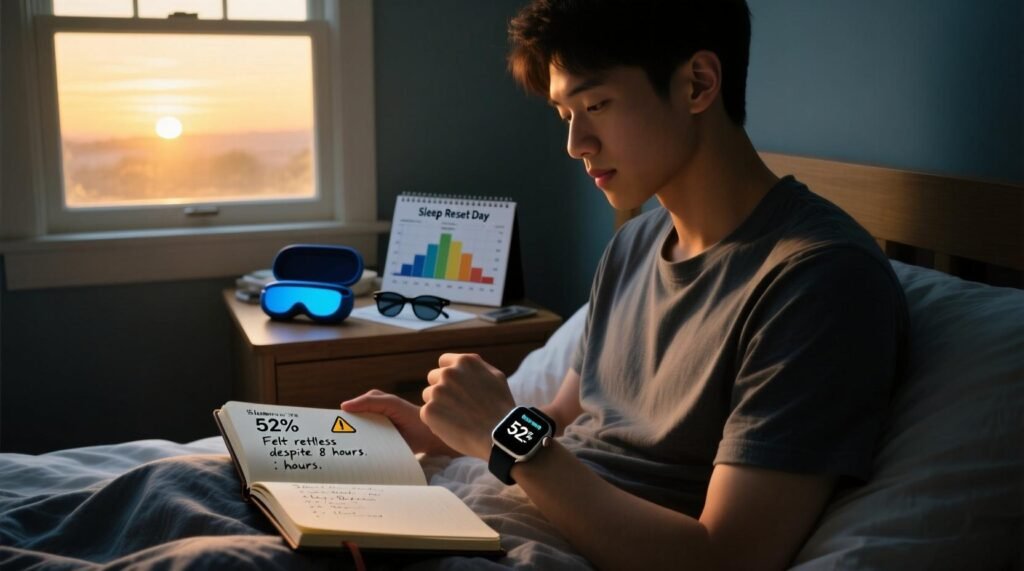
What Is Considered a Good Sleep Efficiency Score?
Quick Answer
Although sleep patterns vary, many sleep specialists use these general ranges:
| Sleep Efficiency Score | General Rating |
| 95–100% | Excellent |
| 90–94% | Very Good |
| 85–89% | Good |
| 80–84% | Fair |
| Below 80% | Lower Sleep Efficiency |
These categories are intended for general guidance rather than diagnosis.
Helpful Sleep Tools
If you’re tracking your sleep habits, these tools work well together:
A Sleep Calculator helps estimate ideal bedtimes based on complete sleep cycles, while a Nap Calculator helps schedule naps that support your nighttime sleep.
Why Does Sleep Efficiency Score Matter?
Quick Answer
A sleep efficiency score shows how effectively you’re sleeping during the time you spend in bed.
Tracking this score over time may help you:
- Identify changes in your sleep routine
- Monitor bedtime consistency
- Compare weekly sleep patterns
- Improve sleep habits
The score becomes more useful when viewed as a long-term trend rather than a single night’s result.
What Can Lower Your Sleep Efficiency Score?
Several everyday habits may reduce your score.
These include:
- Going to bed too early
- Taking a long time to fall asleep
- Frequent nighttime awakenings
- Irregular sleep schedules
- Excessive screen time before bed
- Late caffeine consumption
Making gradual improvements to your bedtime routine may help increase your score.

How Can You Improve Your Sleep Efficiency Score?
Follow a Consistent Schedule
Try to go to bed and wake up at approximately the same time every day.
Create a Sleep-Friendly Bedroom
Aim for:
- A cool room
- Comfortable bedding
- Minimal noise
- Low light
Limit Evening Screen Time
Reducing blue light exposure before bedtime may make it easier to fall asleep.
Track Your Sleep
A sleep diary or wearable tracker can help you monitor changes in your sleep efficiency score.
Can Naps Affect Your Score?
Yes.
Long naps late in the day may make it harder for some people to fall asleep at night.
A Nap Calculator can help estimate a nap duration that supports your overall sleep schedule.
What About Jet Lag?
Travel across multiple time zones can temporarily reduce your sleep efficiency score while your body adjusts.
A Jet Lag Calculator can help estimate how long it may take for your circadian rhythm to adapt.
Frequently Asked Questions
What is a sleep efficiency score?
A sleep efficiency score measures the percentage of time you spend asleep while you’re in bed.
What is considered a good sleep efficiency score?
Many sleep experts consider 85% or higher to be a generally healthy sleep efficiency score.
Can my sleep efficiency score change every night?
Yes. It naturally changes depending on your bedtime routine, sleep quality, and overall sleep schedule.
Is a higher sleep efficiency score always better?
Generally, yes. A higher score usually means you spent more of your time in bed sleeping.
Can sleep trackers calculate sleep efficiency automatically?
Many modern sleep trackers estimate your sleep efficiency score using movement and sleep duration data.
Conclusion
A Sleep Efficiency Score provides a practical way to measure how effectively you’re sleeping each night. By tracking the percentage of time you spend asleep while in bed, you can better understand your sleep habits and make informed adjustments to improve your routine.
Combined with consistent sleep schedules and practical sleep planning tools, monitoring your sleep efficiency score can support healthier long-term sleep habits.