
You may sleep for eight hours every night but still wake up feeling exhausted. The reason could be that your time in bed is not translating into actual restorative sleep. This is where your sleep efficiency score becomes important.
A sleep efficiency score measures the percentage of time you spend asleep compared with the total amount of time you spend in bed. A higher percentage generally indicates better sleep continuity, fewer nighttime awakenings, and more effective rest.
This guide explains what your sleep efficiency score means, what is considered a healthy range, how the score is calculated, and practical steps to improve it.
What Is a Sleep Efficiency Score?
Quick Answer
A sleep efficiency score represents the percentage of your time in bed that you spend actually sleeping.
For example, if you stay in bed for 8 hours but sleep for only 7 hours, your sleep efficiency score is:
(7 ÷ 8) × 100 = 87.5%
A higher score usually means you fall asleep faster, stay asleep longer, and experience fewer disruptions during the night.
How Is Sleep Efficiency Score Calculated?
Quick Answer
Sleep efficiency is calculated by dividing your total sleep time by your total time in bed and multiplying the result by 100.
Sleep Efficiency Formula
Sleep Efficiency (%) = (Total Sleep Time ÷ Total Time in Bed) × 100
Example Calculation
Imagine your sleep data shows:
- Time you went to bed: 10:30 PM
- Time you got out of bed: 6:30 AM
- Total time in bed: 8 hours
- Time awake during the night: 45 minutes
- Total sleep time: 7 hours 15 minutes
Calculation:
7.25 ÷ 8 × 100 = 90.6% sleep efficiency
You can also use a Sleep Efficiency Calculator to automatically calculate your score based on your sleep data.
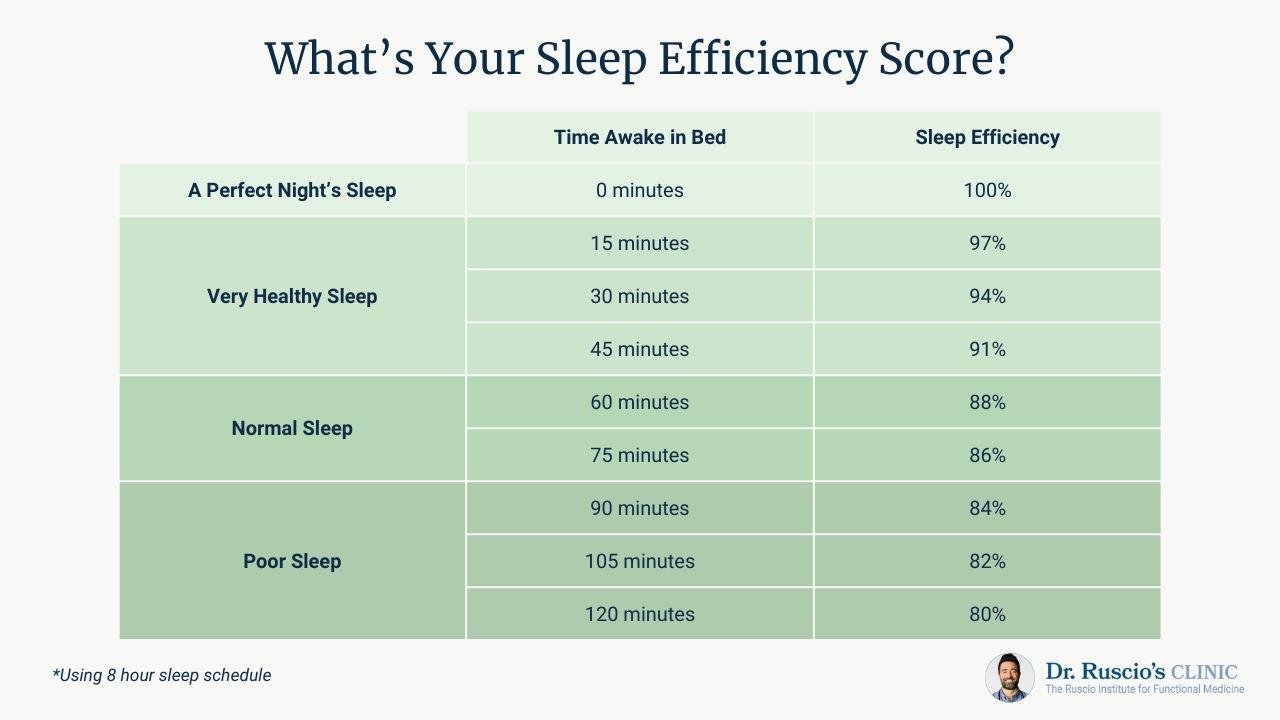
Sleep Efficiency Score Chart
The table below shows general sleep efficiency ranges.
| Sleep Efficiency Percentage | Interpretation |
|---|---|
| 95% or higher | Excellent sleep efficiency |
| 85%–94% | Good and healthy sleep efficiency |
| 75%–84% | Fair sleep efficiency; improvements may help |
| Below 75% | Poor sleep efficiency and frequent wakefulness |
These ranges are guidelines and may vary depending on individual health, age, and sleep circumstances.
What Is a Good Sleep Efficiency Score?
Quick Answer
For most adults, a sleep efficiency score of 85% or higher is considered healthy.
People with good sleep efficiency usually:
- Fall asleep within a reasonable time
- Stay asleep for most of the night
- Have fewer nighttime awakenings
- Wake feeling refreshed
A score below 85% does not always indicate a medical problem, but consistent low scores may suggest that your sleep habits or environment need improvement.
What Causes a Low Sleep Efficiency Score?
Several factors can reduce how effectively you sleep.
Lifestyle Factors
- Irregular sleeping schedules
- Drinking caffeine late in the day
- Alcohol before bedtime
- Excessive evening screen exposure
- High stress or anxiety
Environmental Factors
Poor sleep environments can include:
- Bright lights
- Noise disturbances
- An uncomfortable mattress
- A bedroom that is too hot or too cold
Sleep and Medical Conditions
Persistent low sleep efficiency may be linked to:
- Insomnia
- Sleep apnea
- Restless leg symptoms
- Chronic pain
- Certain medications
If your sleep efficiency remains low for several weeks and affects daily life, consult a healthcare professional.
How to Improve Your Sleep Efficiency Score
1. Keep a Consistent Sleep Schedule
Going to bed and waking up at the same time each day helps stabilize your circadian rhythm.
2. Avoid Spending Too Much Time Awake in Bed
If you cannot sleep after about 20 minutes, consider leaving the bed for a relaxing activity until you feel sleepy again.
3. Create an Ideal Sleep Environment
Improve your bedroom by:
- Keeping the room dark
- Maintaining a cool temperature
- Reducing noise
- Using comfortable pillows and mattresses
4. Reduce Stimulants Before Bed
Try to limit:
- Caffeine in the afternoon or evening
- Nicotine
- Heavy meals close to bedtime
5. Track Other Sleep Metrics
Sleep efficiency is one measurement of sleep health. For a complete picture, monitor:
- Total sleep duration
- Sleep debt
- Sleep cycles
- Sleep consistency
Use a Sleep Debt Calculator to check accumulated sleep loss and a Sleep Calculator to plan the best bedtime and wake-up time.
Sleep Efficiency Score vs Sleep Quality
Although closely related, these terms are not identical.
| Sleep Efficiency Score | Sleep Quality |
|---|---|
| Measures the percentage of time asleep while in bed | Describes how restorative and satisfying sleep feels |
| Based on a mathematical formula | Includes REM sleep, deep sleep, and overall restfulness |
| Focuses on sleep continuity | Includes physical and mental recovery |
Someone can have a high sleep efficiency score but still experience poor sleep quality because of other health or lifestyle factors.
Expert Tip: Focus on Trends, Not a Single Night
A single night with a low sleep efficiency score is not usually a cause for concern. The most useful information comes from monitoring your average sleep efficiency over several weeks.
Sleep journals, wearable devices, and sleep tracking apps can help identify patterns affecting your sleep.
Frequently Asked Questions
What is a good sleep efficiency score?
Most adults should aim for a sleep efficiency score of 85% or higher.
Is 90% sleep efficiency good?
Yes. A sleep efficiency score of 90% generally indicates healthy sleep with minimal time spent awake in bed.
Is 70% sleep efficiency bad?
A score around 70% suggests that a large amount of time in bed is spent awake, and improving sleep habits may be helpful.
How accurate are smartwatch sleep efficiency scores?
Smartwatches provide useful estimates based on movement and sensors, but they are generally less accurate than clinical sleep studies.
Can sleep efficiency improve over time?
Yes. Better sleep habits, a consistent schedule, improved sleep environments, and addressing sleep problems can increase sleep efficiency.
Conclusion
Your sleep efficiency score provides valuable insight into how well you sleep, not just how long you stay in bed. A healthy score is typically 85% or higher, indicating that most of your time in bed is spent sleeping.
If your score is consistently low, improving your sleep routine, reducing nighttime interruptions, and tracking your sleep patterns can help. Combine a Sleep Efficiency Calculator with tools like a Sleep Debt Calculator and Sleep Calculator to build healthier long-term sleep habits.